
Recently, 493 people were scammed by a travel agency and two consultancies under the pretext of sending them to Luxembourg. It was found that some of the victims were even issued work permits by the Department of Foreign Employment based on fake visas and documents.
Tularam Adhikari (40), from Bindabasini, Narayan Municipality-11, Dailekh, saw an advertisement on Facebook. The ad, which he saw in June/July 2024, was for job opportunities in Luxembourg. It stated a demand for 550 workers with salaries ranging from €850 to €3,550 (approximately NPR 137,000 to NPR 572,000 at the current exchange rate). 
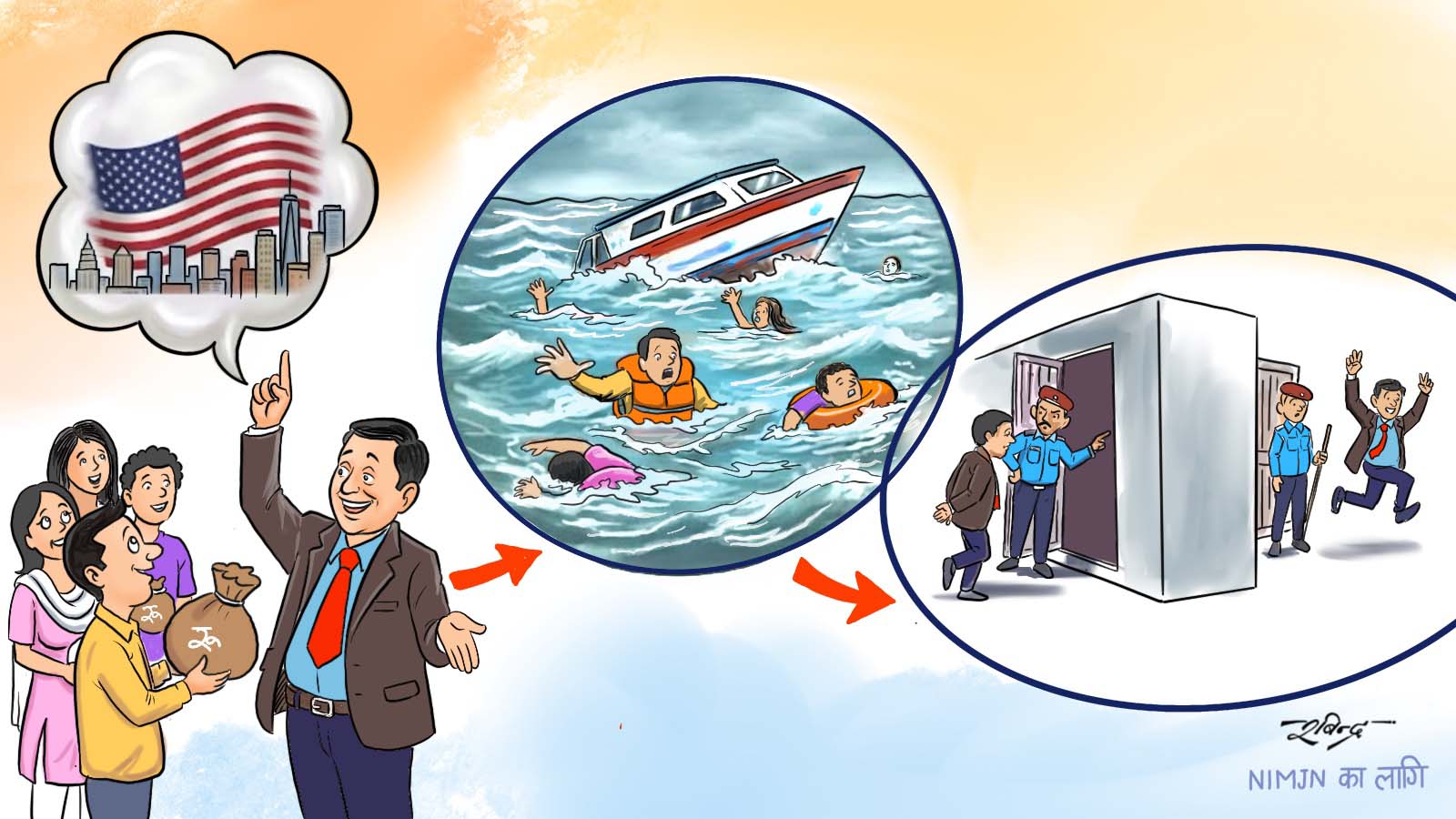
Due to the high demand and attractive salary, Tularam sought out the company's address and found himself at Banglamukhi Tour & Travel Service in Kupandol, Lalitpur. Sixty other young people, including six from his own village, had also seen the same ad and were there.
The agency's owner, Leel Bahadur Roka, a former British Gurkha Army member, told them that the cost to go to Luxembourg would be NPR 800,000.
The job was for food packing with a salary of €2,550. Roka also promised that workers could bring their families and would soon get permanent residency. Tularam was enticed and decided to proceed with the application. "Why wouldn't I go if I could settle in Europe?" he asked.
On July 22, 2024, Tularam received an offer letter from ERA European Recruitment Agency for a job with a salary of €2,550 (approximately NPR 411,000).
After receiving the offer letter, he paid Leel Bahadur a total of NPR 250,000 in three installments: NPR 50,000 initially, then NPR 100,000 after receiving the work permit, and finally NPR 150,000 after receiving the visa.

While the work permit application was being processed at the Department of Foreign Employment, Tularam received a plane ticket with a layover in Istanbul, Turkey, for a January 28, 2025, flight to Luxembourg. After getting the ticket, he paid another NPR 500,000. The remaining balance was to be paid on the day of his flight.
He, however, never made it to Luxembourg. On February 10, 2025, he filed a fraud complaint against the agency owner, Leel Bahadur Roka, and three others with the Department of Foreign Employment. Soon after, others who had been scammed also came forward with complaints. Leel Bahadur was arrested in Bhairahawa, and his employee, Asha Pariyar, was arrested in Kathmandu.
In total, 493 individuals have filed complaints with the department, claiming they were defrauded by misleading advertisements from Leel Bahadur's Banglamukhi Tour & Travel Service and two other consultancies, Pulsewave and SabKura Consultancy, run by a couple, Keshav Gautam and Sharada Rijal. The couple is currently at large. It was found that some of the victims were even issued work permits by the Department of Foreign Employment using fake visas and documents.
Tularam believes he was scammed because he trusted Leel Bahadur's promise to get him to Luxembourg by any means, with a network that supposedly extended through Nepal, New Delhi, Turkey and Luxembourg. "I had to believe him because I have seen agents successfully use connections to get people on flights from Tribhuvan Airport before," he said, adding, "I am a witness to the activities that take place there."
After serving 18 years in the Nepali Army and earning a pension, Tularam had gone to Russia on a tourist visa. He had been working for the Russian Army since September/October 2023. He returned home in June/July 2024 and immediately began the process to go to Luxembourg.
According to Tularam, Leel Bahadur, the owner of Banglamukhi Tourism and Travel Service, had taken 11 people who had received work permits from the Department of Foreign Employment to Delhi and kept them there for 40 days, promising to get them to Luxembourg.
Tularam states that after they failed to get them on a flight from Tribhuvan International Airport with their connections, they canceled the tickets and took them to Delhi instead. "We realized we had been scammed when the agent who went with us fled after failing to get us on a flight from Delhi," he said. After the agent fled, the Kupandol office was closed, and four of its employees also disappeared.
According to Sudip Bhandari (34) of Imadol, Lalitpur, the agency told 11 of the 16 applicants in his group that their visas and company work permits had arrived, and they were just waiting for the work permits from the Department of Foreign Employment.
Durga Neupane (34) from Dailekh says that Leel Bahadur took money from them, promising they would be next after those 11 people had departed for Luxembourg.
Alok Chaudhary (33) from Itahari, another applicant for a job in Luxembourg, says he was convinced because the work permits had even been approved by the Department of Foreign Employment.
Work permits issued based on recommendations of company without permission
Under the Foreign Employment Act, 2007, only licensed institutions established under the prevailing Company Act are allowed to send workers for foreign employment. This act prohibits consultancies and travel agencies from engaging in this business.
The law requires that after a licensed institution selects workers and they receive their visas, the institution must obtain a work permit from the Department of Foreign Employment. For individual work permits, the person must be present, while for institutional permits, a representative from the institution must be present.
However, the Department of Foreign Employment violated this law by issuing work permits to individuals selected and recommended by Pulsewave Consultancy, SabKura Consultancy and Banglamukhi Tour & Travel Service, none of which are licensed to send workers abroad. By issuing work permits based on documents from unauthorized institutions, the department itself has broken the law.
For example, Rajina Rai of Ramechhap received a work permit from the department on January 1, 2025. She was approved for a food packing job at the European Recruitment Agency with a salary of €2,550.
Similarly, on January 9, 2025, Suman Fuyal's passport was issued a work permit for a housekeeping job with a salary of €850.
The Department of Foreign Employment's website also shows a work agreement for Sudarshan Gartoula for a general worker position with a salary of €850.
According to the former Director-General of the Department of Foreign Employment, Surya Bahadur Khatri, such mistakes may have occurred due to a lack of technology to verify fake documents and visas.
According to Shreedhar KC, the head of the Department of Foreign Employment's individual work permit branch, the department lacks the technology to verify visas, work permits, and other documents from countries like Canada and those in Europe.
KC says they only have the technology to check visas and documents for Gulf countries such as Qatar, Bahrain, UAE and Saudi Arabia. He explains that to check a visa, they need access to the destination country's website. "Without access and technology, they all look the same when we check them visually; we can't tell them apart," he said.
According to Pramod Adhikari, an employee in the individual work permit branch, sometimes the website to verify visas is not available, and embassies do not respond to email inquiries.
Dunduraj Ghimire, spokesperson for the Ministry of Labor and Employment, stated that they often issue work permits based on assumptions because they cannot determine if the visas and documents for individual work permits are genuine. "It's not possible to have the technology to check visas and documents for every country," he said, adding that "the individuals themselves must be responsible."
In 2018/19, a case was filed in a special court against 27 individuals, including 25 department employees and two middlemen, for issuing work permits based on fake documents. The Commission for the Investigation of Abuse of Authority filed the charges after discovering that work permits had been issued to 184 women going to Kuwait using fraudulent documents.
This lack of technology is not limited to the work permit branch of the department; the immigration office at Tribhuvan International Airport also lacks the technology to verify the authenticity of visas and documents for people traveling abroad. According to Deepak Dhakal, information officer for the Department of Immigration, this technology has not yet been installed.
Fake visas and documents
The Embassy of Luxembourg in New Delhi, India, has confirmed that all documents – offer letters, work permits and visas – prepared for individuals seeking to go to Luxembourg through Banglamukhi Tour & Travel Service, SabKura Consultancy and Pulsewave Consultancy were fake. This confirms that the Department of Foreign Employment issued work permits based on fraudulent visas.
We contacted the Embassy and Visa Center of Luxembourg in Delhi to inquire about the offer letters and visas issued to individuals who had responded to job advertisements on social media platforms like Facebook and TikTok.
In a response on November 6, 2024, the embassy's communication department stated that they had not requested any workers through Nepali consultancies, agencies or manpower companies. The embassy subsequently issued a public notice on its website, warning people not to trust job advertisements on social media. The notice clarified that Luxembourg was not recruiting workers through any consultancies or manpower companies and had not issued any visas for employment purposes.
 On March 22, 2025, we sent the documents, including the offer letters, visas, and work permits, for Tularam, Sudip Bhandari, Rajina Rai and others from the European Recruitment Agency to the Luxembourg Embassy in Delhi for verification.
On March 24, 2025, the embassy confirmed that their visas were not issued by the embassy and that the offer letters and work permits were also fake.

In a third correspondence on May 21, 2025, the Delhi embassy reiterated that no workers for employment in Luxembourg had been requested through any agency and that the embassy had no relationship with any of them.
With a population of 672,000, Luxembourg does not import workers from Nepal, nor does it import them from any other country in South Asia.
Scammed even after knowing it was fake
Rajina says that Banglamukhi Tour & Travel Service took between NPR 300,000 and NPR 700,000 from each of the 150 people, divided into three groups. She and her three siblings paid a total of NPR 2,800,000 at a rate of NPR 700,000 each. "We were scammed because we believed the agent could get us on the flight through his connections no matter what," she says.
Even after her documents and visa arrived, Rajina says she still had doubts about their authenticity but paid the full amount anyway. "Once you decide to go, you become single-minded. We couldn't tell what was real and what wasn't, and we didn't listen to anyone," she explains. The agents had told them they would be taken to Luxembourg on a tourist visa from either Nepal or Delhi airport and that it would be converted to a working visa once they arrived.
Sabina Singh Khadgi from Koteshwor was also scammed in a similar manner after seeing an advertisement for a job in Luxembourg at SabKura Consultancy in Baneshwor, Kathmandu.
Initially, she didn't trust the staff's promises. To win her trust, the consultancy offered to accept payment only after the visa was issued. Only then did she, her brother and her sister-in-law apply for the jobs. They each paid NPR 50,000.
A month later, they received job offer letters from a company in Luxembourg called Nexu, followed by work permits. She was still suspicious, and when she couldn't find the documents online, she says SabKura Consultancy's owner, Keshav Gautam, insisted that all the documents were genuine.
After losing trust in Gautam, they went to the consultancy to ask for their money back. They were told that the money for all three of them would be returned in 22 days. When they returned on the scheduled day and time, they found that the consultancy was closed, and Gautam and his wife, along with their employees, had fled.
After the consultancy closed, the victims went to the home of the owner, Keshav Gautam, in Phulbari, Lalitpur, and found only his sister and two children. The victims had his sister sign documents agreeing to pay back all the money owed. The next day, she locked the house and fled.
Subsequently, victims including Ramesh Chaudhary from Rautahat filed a complaint with the Department of Foreign Employment against Keshav Gautam and his wife, Sharada Rijal. The department has received 318 complaints of fraud from individuals scammed by SabKura and Pulsewave Consultancies. It is alleged that Keshav and Sharada also defrauded people of NPR 15.9 million through Pulsewave Consultancy by promising them jobs in Luxembourg.
Similarly, according to Rajina, who had started the process to go abroad through Banglamukhi, 150 people paid between NPR 300,000 and NPR 700,000 each. She says she and her three siblings paid NPR 2,800,000 in total. By February/March 2025, the number of complaints reached 175.
Despite the complaints from the victims, Leel Bahadur, the owner of Banglamukhi, has claimed he was not involved in sending people abroad. In his statement to the Foreign Employment Tribunal, he said that the process to send people abroad began while he was in Dubai, and therefore, the co-owners and employees of the agency should be held responsible.
Registered as consultancy, but works as manpower agency
The number of consultancies in Nepal has increased significantly since 2018, a change that can be attributed to an amendment to the Foreign Employment Act of 2007. The amendment increased the deposit required for manpower agencies to NPR 20 million and raised the minimum number of workers to be sent abroad annually to 3,000. According to Shesh Raj Bhattarai, president of the Nepal Educational Consultancy Association (ECAN), manpower entrepreneurs then began operating consultancies instead.
He alleges that those who cannot afford to invest the large sum required to register as a manpower agency are now operating consultancies and engaging in illegal activities.
According to Som Luitel, a migration expert at People's Forum for Human Rights, the law stipulates that foreign employment is only possible through G2G (government-to-government) agreements or licensed manpower agencies. For either, a work permit is mandatory.
The Department of Foreign Employment states that there is a lower chance of being scammed when people go abroad through legal channels. Even if a person is scammed, there are provisions to provide compensation from the deposit the manpower agency has placed with the department.
However, educational consultancies are increasingly scamming workers with the promise of jobs in European countries, while the Ministry of Education, the regulatory body, remains silent. The lack of monitoring has allowed these consultancy owners to expand their fraudulent activities.
Educational consultancies are registered under the Ministry of Education, Science, and Technology. However, according to Nilkantha Dhakal, an information officer at the Ministry of Education, regulation and monitoring have not been possible since the 2015 Constitution delegated the authority to operate these institutions to the provincial level.
Despite the issue being connected to the Ministry of Education, a special unit has been established within the Department of Foreign Employment to handle complaints from victims, as these scams are related to foreign employment.
Section 16(d) of the Education Act 2028 (1971) (Ninth Amendment-2017) states that educational counseling services, foreign educational programs, language teaching, and educational programs cannot be operated without a permit. Additionally, ECAN established a code of conduct in 2006/2007, stating that its members are not allowed to engage in foreign employment or other similar activities.
If a consultancy sends someone for foreign employment, the Department of Foreign Employment should look into it. However, if any other regulatory action, punishment, or license cancellation is needed, it must be handled by the Ministry of Education, the body that registered the consultancy. According to Nilkantha Dhakal, the ministry's information officer, while the ministry is responsible for monitoring and regulating these consultancies after they are registered, it has not been able to do so.
The Ministry of Education has not registered any consultancies since 2017. Currently, these educational consultancies can be registered at the provincial level, which has created a dispute over who is responsible for their regulation and monitoring. However, the Department of Foreign Employment maintains that the registering body itself should be responsible for their monitoring and regulation. There are more than 5,000 consultancies in Nepal, of which over 1,400 are registered under the Ministry of Education alone.
According to Surya Bahadur Khatri, the former Director-General of the Department of Foreign Employment, the department can take action if it is proven that money was paid for foreign employment. However, he says it is difficult to bring cases under their jurisdiction because most of the documents submitted by those who come to complain do not show that money was paid for foreign employment.
Due to the government's inability to create a separate law or its weak enforcement of existing regulations, educational consultancies are also scamming young people in the name of worker visas.
Although the government claims to be monitoring and regulating consultancies through the Educational Counseling Services and Language Teaching Directive of 2018, its implementation appears to be weak. The inability to monitor and regulate has led to an increase in fraudulent activities, with unregistered consultancies also scamming young people out of millions of rupees.
Scams due to unregulated fees for Europe
Nepal has recently seen a growing trend of people choosing Europe as a work destination. As the number of Nepalis seeking employment there has increased, a fixed fee was set for going to countries like the UK. However, this policy was later removed, and the related documents cannot be found at the Ministry or the Department of Foreign Employment. Som Luitel, a labor migration expert, says, "If that decision had been kept, far fewer young people would have been scammed."
The Foreign Employment Act has a provision that allows for a fee to be set. Luitel believes that if fees were to be fixed for countries in Europe, including the UK, and workers were sent through manpower agencies, such malpractice would decrease.
He also notes that a rule was made to stop issuing work permits to individuals going for employment through personal contracts (except for family members) due to the high rate of fraud and abuse, but this rule did not last long.
Former Minister of Labor, Dol Prasad Aryal, says he found that the department was reluctant to set fees because it would become a source of controversy.
According to Luitel, no other country in South Asia has a policy of issuing individual work permits, nor do many other countries. Instead, they issue work permits by classifying job specialties.
While this system supports "freedom of mobility," it has recently created many problems. For a person to be eligible for a work permit under a personal contract, they must be qualified. When semi-skilled workers are sent through manpower agencies, it's easier to take action if they run into problems. With individual contracts, it is difficult to identify the person to file a complaint against if a problem arises.
The Foreign Employment Act of 2007 introduced individual work permits as an option. However, without a proper policy directive to regulate it, the system was abused. For a while, the government tightened the rules for individual work permits, but they were later relaxed. Now, according to migration expert Som Luitel, it has become chaotic. He states that because the identities of those taking people abroad on individual work permits are not revealed, it has become difficult to take legal action and prosecute them.
Section 117 of the Muluki Criminal Procedure Code Act of 2017 states that in a case related to foreign employment, if both the defendant and the victim submit a request to the Nepal government for an amicable settlement and the government finds the request reasonable, it can order a public prosecutor to facilitate a settlement. According to the act, a settlement can be reached at any stage of the case, either before a verdict is delivered or during an appeal.
The law has a provision for a settlement once a case reaches the Foreign Employment Tribunal. Additionally, the Chief District Officer has the authority to mediate individual cases. While this is the legal provision, in practice, all types of cases are settled at the investigative level by the Department of Foreign Employment, the Chief District Officer, and at the Foreign Employment Tribunal.
It appears that victims who settle their cases do not receive the additional compensation provided by law. Luitel states that cases of fraud by agencies, manpower companies, and consultancies can also be prosecuted under foreign employment fraud.
According to a 2017/2018 study by the People's Forum on the implementation of verdicts from the Foreign Employment Tribunal, victims received 96.56% of the principal amount in compensation through settlements. There does not appear to be any integrated data on the settlements facilitated by the District Administration Office.
56% in favor of the victims
Nepali law classifies foreign employment fraud as a criminal case initiated by the government, yet victims are often unable to receive proper justice. A study conducted by People's Forum shows that the government has won only 56% of foreign employment cases in favor of the victims.
Even in the cases won, only 10.81% of victims received compensation. Through settlements, victims received only 96.56% of their principal amount. This issue is caused by a centralized judicial structure, lengthy legal procedures, complex verdict enforcement, and a lack of legal knowledge among victims.
Despite the existence of three levels of government in the country, and a directive from the Supreme Court, people are still forced to travel to Kathmandu for foreign employment justice. Other major challenges include the ineffective implementation of human trafficking laws, the inability to appoint police attachés abroad (except in India), the difficulties Nepalis face in getting justice in foreign countries for various reasons, a lack of sufficient legal provisions for human trafficking, and deficiencies in case investigation.
Investigations are not effective because they must be carried out by a centralized department with limited staff, which is also tasked with investigating all foreign employment cases nationwide. The investigation process requires officers with a prosecution background and sufficient resources. It is essential to localize the foreign employment justice process.
According to a Supreme Court order issued on March 15, 2017, the administration of foreign employment justice should take place at the provincial level. Arrangements should be made for victims to file complaints in their local areas. The law also states that the police should be given the authority to investigate cases where manpower companies or agents have committed fraud.
To bring fraud cases that occur abroad into the legal framework, a system should be established to appoint police attachés in countries with a high number of Nepali workers and to strengthen the process of filing cases. To stop fraud and trafficking, there is a need for effective legal provisions, the implementation of short-term procedures, and a simplified enforcement of verdicts.
Migration expert Som says that public awareness about foreign employment legal procedures should be increased through the cooperation of local governments and civil society. Additionally, free legal aid should be provided to victims of foreign employment fraud.
Please adhere to our republishing policy if you'd like to republish this story. You can find the guidelines here.





Comments